
The Man Behind the Method: The Story of Joseph Pilates
Today, Pilates is practiced by millions of people around the world, celebrated for its ability to build strength, improve flexibility, enhance balance, and encourage mindful movement.
But before Pilates became a globally recognized fitness method, it was the vision of one man: Joseph Hubertus Pilates.
More than a century ago, Joseph Pilates began developing an approach to movement that challenged traditional ideas about exercise. His belief was simple yet powerful: physical and mental well-being are deeply connected, and intentional movement is essential to a healthy life.
At Studio 12 Pilates, we're inspired by the history and principles behind this method. Understanding where Pilates began gives us a greater appreciation for the practice we know and love today.
From a Sickly Childhood to a Passion for Movement
Joseph Pilates was born in 1883 near Düsseldorf, Germany. According to biographical accounts, he struggled with several childhood health conditions, including asthma, rickets, and rheumatic fever.
Rather than allowing these challenges to define him, he developed a fascination with physical fitness and the human body.
He explored gymnastics, bodybuilding, boxing, diving, and various movement philosophies, drawing inspiration from both Eastern and Western traditions.
These early experiences helped shape his belief that developing physical strength, flexibility, and control could contribute to better overall health.
What began as a personal pursuit would eventually become the foundation of an entirely new exercise method.
The Birth of Contrology
In 1912, Pilates moved to England. When World War I began in 1914, he was interned as a German national, eventually spending time at a camp on the Isle of Man.
During this period, he continued developing and teaching his approach to physical conditioning.
Historical accounts suggest that he experimented with exercises and equipment to help people maintain strength and mobility, including those who were injured or confined to bed.
One frequently told story credits hospital bed springs as the inspiration for his later resistance-based equipment. While the exact details are difficult to verify, this period is widely recognized as an important chapter in the development of his method.
Joseph Pilates called his approach Contrology, emphasizing the importance of consciously controlling the body's movements.
Rather than focusing on isolated muscles, Contrology encouraged the body to work as an integrated system, combining strength, coordination, alignment, concentration, and breath.
As Pilates famously wrote in his 1945 book Return to Life Through Contrology:
"Physical fitness is the first requisite of happiness."
For Joseph Pilates, exercise was never simply about appearance. It was about creating a body capable of moving efficiently and supporting a healthy, active life.
Bringing Pilates to New York City
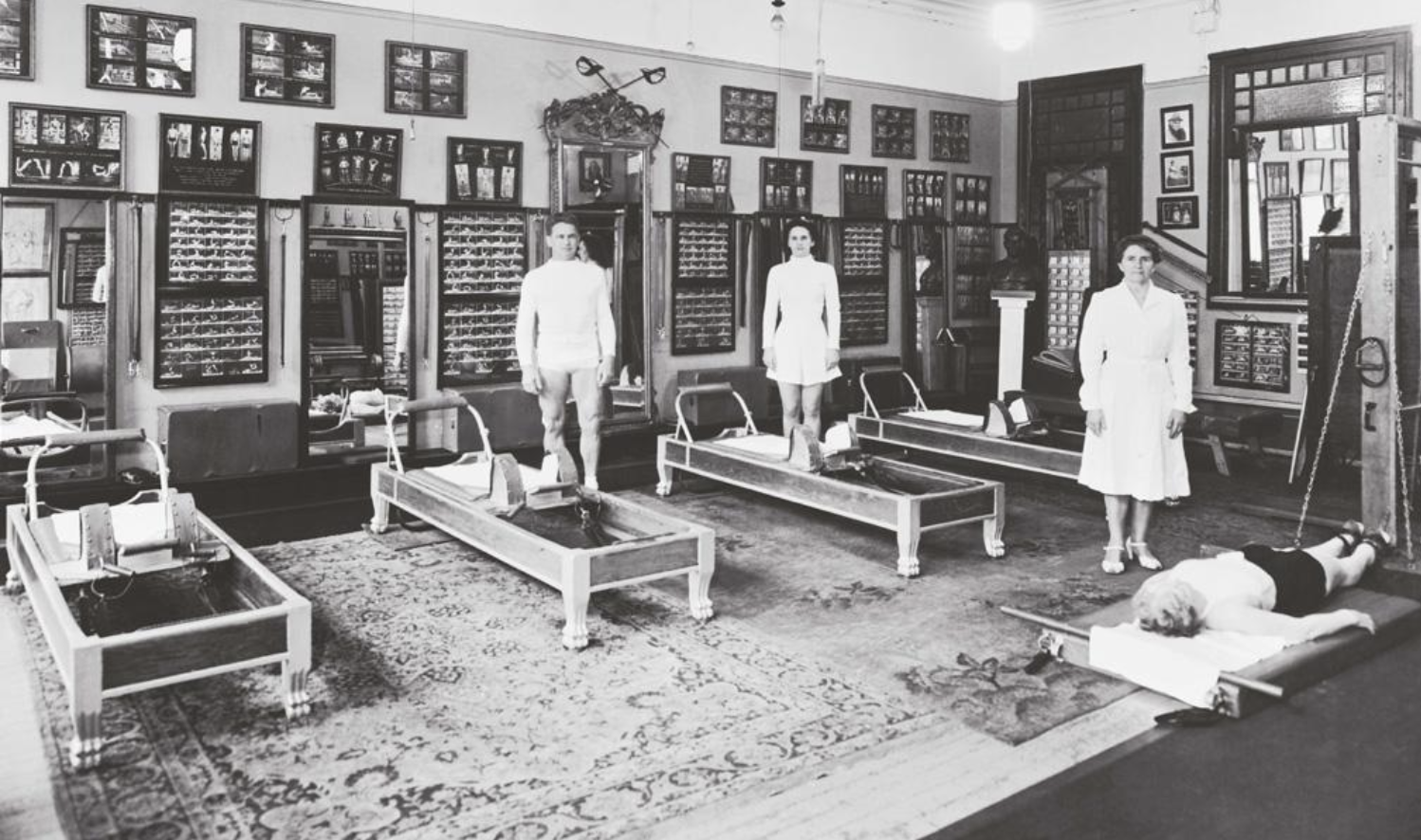
In 1926, Joseph Pilates immigrated to the United States. During his journey, he met Clara, who would become his wife and an essential partner in developing and teaching the method.
Together, they opened a studio on Eighth Avenue in New York City.
Their studio attracted a diverse clientele, but Pilates quickly became particularly popular within the dance community.
Prominent figures, including George Balanchine and Martha Graham, recognized the value of Pilates for conditioning, body awareness, and supporting dancers' physical demands.
Joseph and Clara's studio became a place where movement was approached with precision, intention, and a deep understanding of how the body functions.
Their work helped establish Pilates as a respected method of physical conditioning, laying the groundwork for its continued growth.
The Invention of the Pilates Reformer
One of Joseph Pilates' most influential contributions was the development of specialized exercise equipment.
He created apparatuses including the Reformer, Cadillac, Wunda Chair, and Spine Corrector, each designed to challenge the body through controlled movement and resistance.
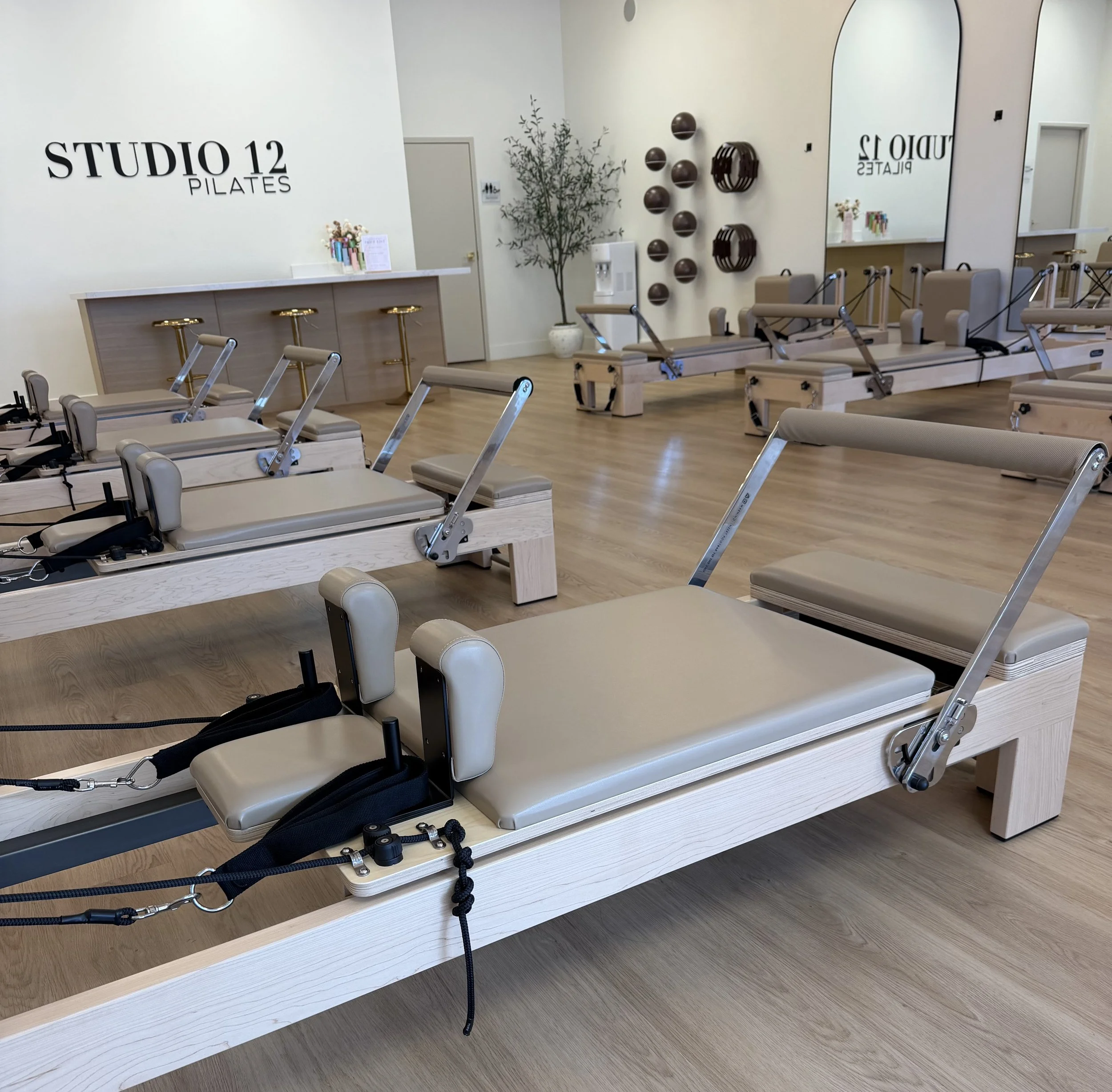
The Pilates Reformer, now one of the most recognizable pieces of Pilates equipment, uses a moving carriage, adjustable springs, straps, and a footbar to create resistance and support a wide variety of exercises.
Unlike traditional weight machines, the reformer challenges multiple muscle groups to work together while emphasizing stability, alignment, and control.
Its versatility allows exercises to be modified for different experience levels and physical abilities, making it an adaptable tool for developing strength, coordination, mobility, and balance.
More than a century after Joseph Pilates began developing his method, the reformer remains central to Pilates studios around the world, including Studio 12.
The Principles That Continue to Shape Pilates
Although the familiar six Pilates principles were formally organized by later teachers, they reflect the fundamental ideas behind Joseph Pilates' original work.
Concentration: Bringing intention and awareness to every movement.
Control: Moving with precision rather than relying on momentum.
Centering: Engaging the body's core, traditionally called the "Powerhouse."
Precision: Prioritizing proper alignment and movement quality.
Breath: Coordinating breathing with controlled movement.
Flow: Creating smooth, connected movement throughout the workout.
Together, these principles distinguish Pilates from many other forms of exercise.
They remind us that how we move is just as important as how much we move.
A Legacy That Lives On
Joseph Pilates continued teaching and refining his method until his death in 1967 at age 83.
His legacy was carried forward by Clara and a dedicated group of students, often referred to as the Pilates Elders, who preserved, taught, and expanded his work for future generations.
Today, Pilates has evolved into a worldwide practice, with both classical and contemporary approaches that reflect the method's continued development.
Yet its foundational philosophy remains remarkably relevant: building strength, improving movement quality, and creating a meaningful connection between mind and body.
Honoring the Method at Studio 12 Pilates
At Studio 12 Pilates, we believe that the principles Joseph Pilates developed more than a century ago are just as valuable today.
Our approach to reformer Pilates is rooted in classical foundations, combining intentional movement, expert instruction, and thoughtfully designed classes that challenge and support the body.
With just eight reformers in our Folsom studio, we're able to provide personalized attention in a welcoming environment where every client can feel confident in their practice.
Whether you're stepping onto a reformer for the first time or continuing to deepen your Pilates journey, you're participating in a method with more than 100 years of history behind it.
One man. One method. A legacy of movement that continues to inspire generations.
Discover the difference at Studio 12 Pilates.
Explore Our Classes at Studio 12 Pilates
Sources & Further Reading
1. Cooper, Kristi. Pilates Anytime. Pilates History: Who Was Joseph Pilates? Primary biographical source for Joseph Pilates' early life, development of Contrology, New York studio, apparatuses, and legacy. Read article
2. Pilates, Joseph H. (1945). Return to Life Through Contrology. Original publication describing Joseph Pilates' philosophy and mat exercise method. Explore the book and its history
3. Pilates, Joseph H. (1934). Your Health: A Corrective System of Exercising That Revolutionizes the Entire Field of Physical Education. Joseph Pilates' early written explanation of his philosophy of physical fitness. Learn more
4. Pilates Anytime. Pilates Legacy. Historical resources, interviews, and information about the Pilates Elders and the lineage of Joseph Pilates' method. Explore Pilates history
5. Latey, Penelope (2001). The Pilates Method: History and Philosophy. Journal of Bodywork and Movement Therapies, 5(4), 275–282. Academic discussion of the historical development and philosophy of Pilates. Find the publication
Historical note: Some details of Joseph Pilates' early life and the development of his equipment come from accounts passed down through Pilates teaching traditions and are not independently documented. The six commonly taught Pilates principles were formalized after Joseph Pilates' original writings.